Be yourself; Everyone else is already taken.
— Oscar Wilde.
This is the first post on my new blog. I’m just getting this new blog going, so stay tuned for more. Subscribe below to get notified when I post new updates.
Hello everyone. My name is Cristina, and I have created this blog in order to help you stay tuned with what happens around the world in the matter of economics. Hope you will enjoy.
Be yourself; Everyone else is already taken.
— Oscar Wilde.
This is the first post on my new blog. I’m just getting this new blog going, so stay tuned for more. Subscribe below to get notified when I post new updates.
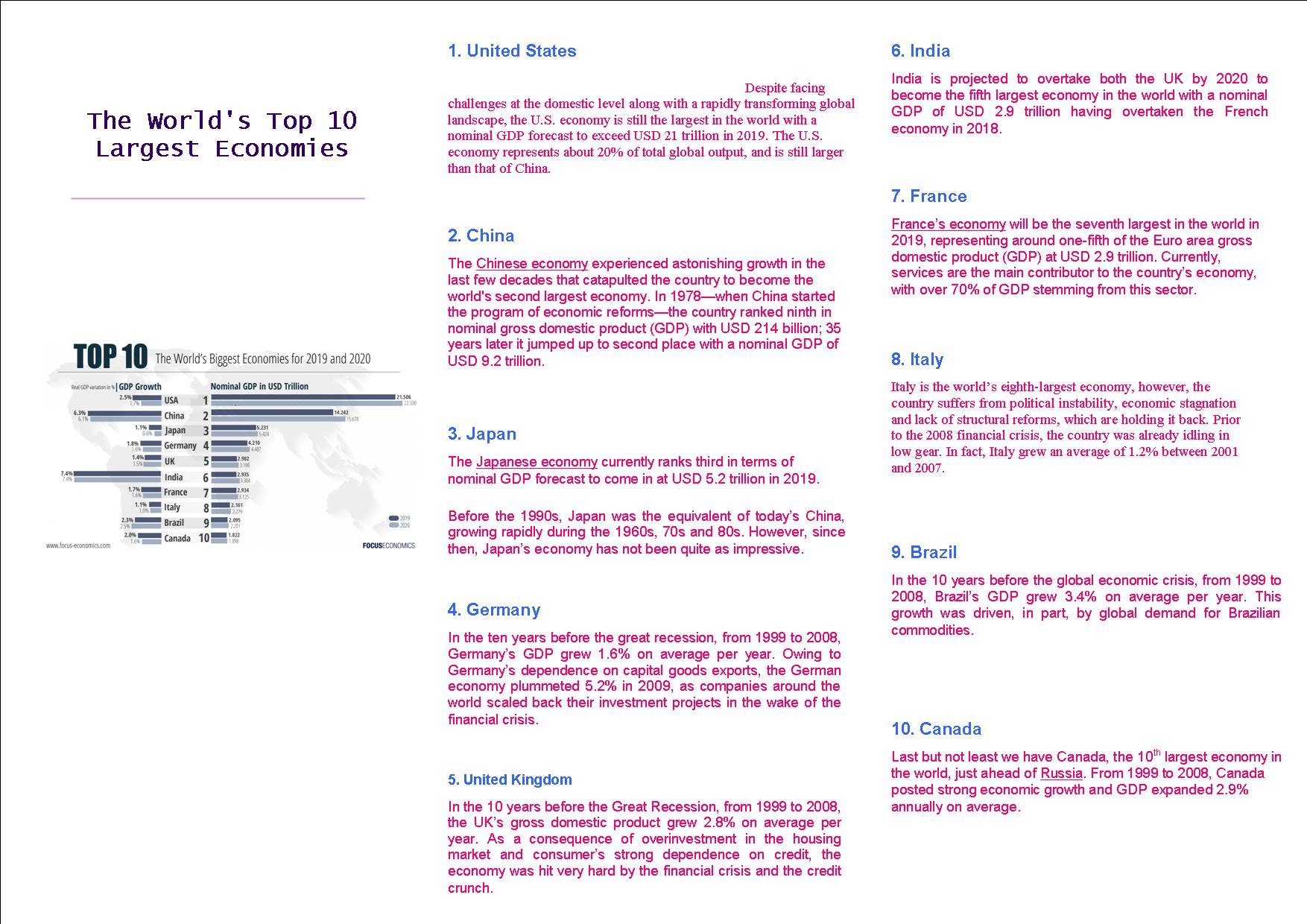
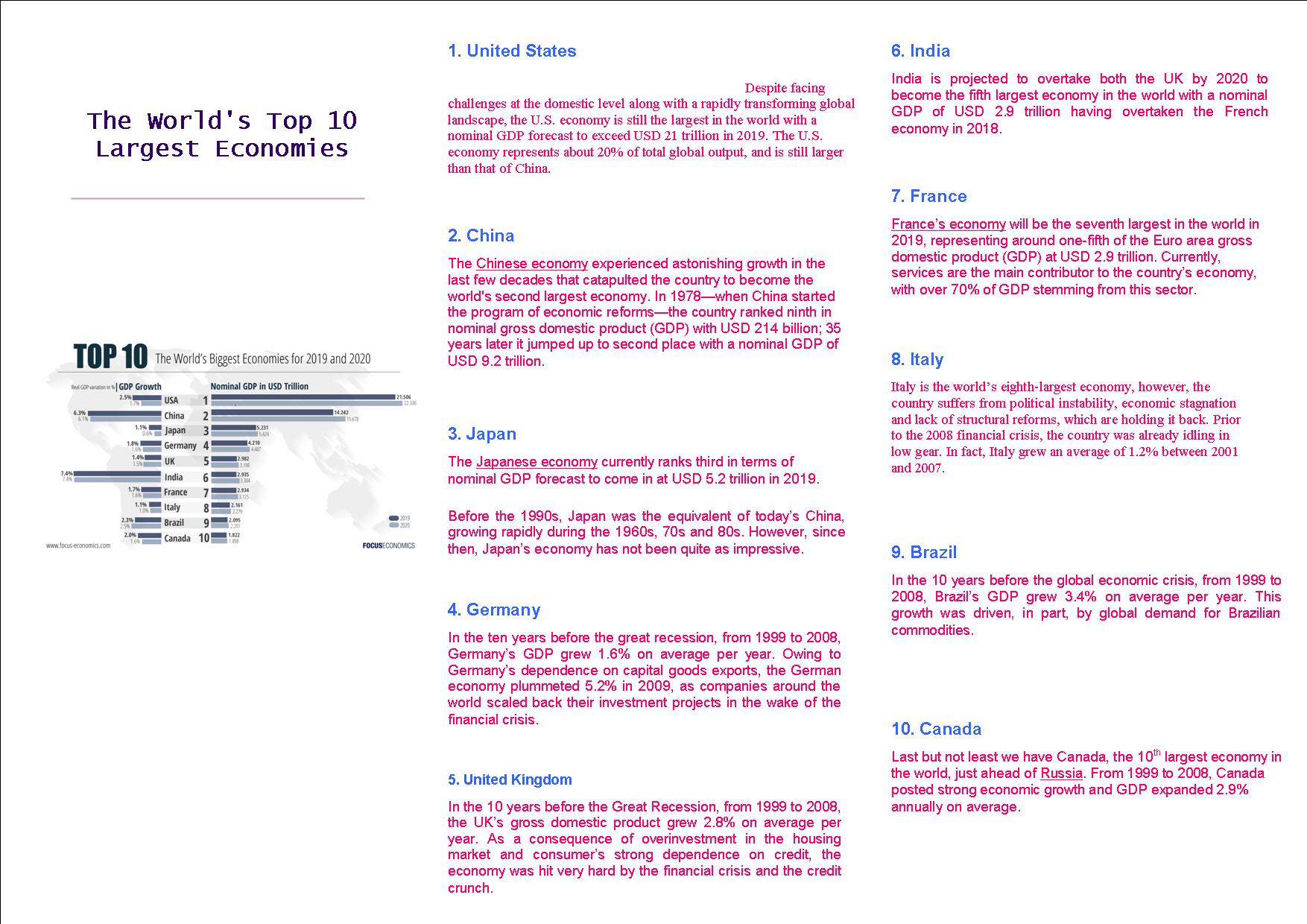
The economy of France is highly developed and free-market-orientated. It is the world’s 7th largest economy by 2019 nominal figures and the 10th largest economy by PPP figures. It is the 3rd largest economy in the European Union after Germany and United Kingdom.
France has a diversified economy. The chemical industry is a key sector for France, helping to develop other manufacturing activities and contributing to economic growth. France’s tourism industry is a major component of the economy, as France is the most visited destination in the world. Sophia Antipolis is the major technology hub for the economy of France. Paris is ranked as the most elegant city in the world, which propels the agglomeration of the fashion industry. According to the IMF, in 2018, France was the world’s 19th country by GDP per capita with $42,878 per inhabitant. In 2017, France was listed on the United Nations’s Human Development Index with a value of 0.901 (indicating very high human development) and 21st on the Corruption Perceptions Index in 2018.The OECD is headquartered in Paris, the nation’s financial capital.
Energy
France is the world-leading country in nuclear energy, home of global energy giants Areva, EDF and GDF Suez: nuclear power now accounts for about 78% of the country’s electricity production, up from only 8% in 1973, 24% in 1980, and 75% in 1990. Nuclear waste is stored on site at reprocessing facilities. Due to its heavy investment in nuclear power, France is the smallest emitter of carbon dioxide among the seven most industrialized countries in the world.
In 2006 electricity generated in France amounted to 548.8 TWh, of which:
In November 2004, EDF (which stands for Electricité de France), the world’s largest utility company and France’s largest electricity provider, was floated with huge success on the French stock market. Notwithstanding, the French state still retains 70% of the capital.
Other electricity providers include Compagnie nationale du Rhône (CNR) and Endesa (through SNET).
Agriculture
France is the world’s sixth largest agricultural producer and EU’s leading agricultural power, accounting for about one-third of all agricultural land within the EU.
Northern France is characterized by large wheat farms. Dairy products, pork, poultry, and apple production are concentrated in the western region. Beef production is located in central France, while the production of fruits, vegetables, and wine ranges from central to southern France. France is a large producer of many agricultural products and is currently expanding its forestry and fishery industries. The implementation of the Common Agricultural Policy (CAP) and the Uruguay Round of the General Agreement on Tariffs and Trade (GATT) have resulted in reforms in the agricultural sector of the economy.
As the world’s second-largest agricultural exporter, France ranks just after the United States.[46] The destination of 49% of its exports is other EU members states. France also provides agricultural exports to many poor African countries (including its former colonies) which face serious food shortages. Wheat, beef, pork, poultry, and dairy products are the principal exports.
Exports from the United States face stiff competition from domestic production, other EU member states, and third-world countries in France. US agricultural exports to France, totaling some $600 million annually, consist primarily of soybeans and soybean products, feeds and fodders, seafood, and consumer products, especially snack foods and nuts. French exports to the United States are much more high-value products such as its cheese, processed products and its wine.
The French agricultural sector receives almost €11 billion in EU subsidies. France’s competitive advantage is mostly linked to the high quality and global renown of its produce, such as cheese and wine.
Tourism
France is the most popular tourist destination with more than 83.7 million foreign tourists in 2014, ahead of Spain (58.5 million in 2006) and the United States (51.1 million in 2006). This figure excludes people staying less than 24 hours in France, such as northern Europeans crossing France on their way to Spain or Italy during the summer.
France is home to cities of much cultural interest (Paris being the foremost), beaches and seaside resorts, ski resorts, and rural regions that many enjoy for their beauty and tranquillity. France also attracts many religious pilgrims to Lourdes, a town in the Hautes-Pyrénées département, which hosts several million visitors a year.
The economy of Kyrgyzstan is heavily dependent on the agricultural sector. Cotton, tobacco, wool, and meat are the main agricultural products, although only tobacco and cotton are exported in any quantity. According to Healy Consultants, Kyrgyzstan‘s economy relies heavily on the strength of industrial exports, with plentiful reserves of gold, mercury, uranium and natural gas.
Agriculture

Agriculture remains a vital part of Kyrgyzstan’s economy and a refuge for workers displaced from industry. Subsistence farming has increased in the early 2000s. After sharp reductions in the early 1990s, by the early 2000s agricultural production was approaching 1991 levels. Grain production in the lower valleys and livestock grazing on upland pastures occupy the largest share of the agricultural workforce. Farmers are shifting to grain and away from cotton and tobacco. Other important products are dairy products, hay, animal feed, potatoes, vegetables, and sugar beets. Agricultural output comes from private household plots (55 percent of the total), private farms (40 percent), and state farms (5 percent). Further expansion of the sector depends on banking reform to increase investment, and on market reform to streamline the distribution of inputs. Land reform, a controversial issue in Kyrgyzstan, has proceeded very slowly since initial legislation in 1998. The irrigation infrastructure is in poor condition. Agriculture contributes about one-third of the GDP and more than one-third of employment.
Industry and manufacturing
In the post-Soviet era, Kyrgyzstan’s industries suffered sharp reductions in productivity because the supply of raw materials and fuels was disrupted, and Soviet markets disappeared. The sector has not recovered appreciably from that reduction; if gold production is not counted, in 2005 industry contributed only 14 percent of the gross domestic product (GDP). Investment and restructuring have remained at low levels, and the electricity industry (traditionally an important part of industry’s contribution to GDP) has stagnated in recent years. Government support is moving away from the machine industries, which were a major contributor to the Soviet economy, toward clothing and textiles. Food processing accounted for 10 to 15 percent of industrial production until encountering a slump in 2004. In recent years, the glass industry has surpassed clothing and textiles in investment received and as a contributor to GDP. In the early 2000s, the construction industry has grown steadily because of large infrastructure projects such as highways and new gold mines. Housing construction, however, has lagged because of low investment
Services
Substantial post-Soviet growth in the services sector is mainly attributable to the appearance of small private enterprises. The central bank is the National Bank of the Kyrgyz Republic, which nominally is independent but follows government policy. Although the banking system has been reformed several times since 1991, it does not play a significant role in investment. High interest rates have discouraged borrowing. A stock market opened in 1995, but its main function is trading in government securities. Because of the Akayev regime’s economic reforms, many small trade and catering enterprises have opened in the post-Soviet era. Although Kyrgyzstan’s mountains and lakes are an attractive tourist destination, the tourism industry has grown very slowly because it has received little investment. In the early 2000s, an average of about 450,000 tourists visited annually, mainly from countries of the former Soviet Union.
This is an example post, originally published as part of Blogging University. Enroll in one of our ten programs, and start your blog right.
You’re going to publish a post today. Don’t worry about how your blog looks. Don’t worry if you haven’t given it a name yet, or you’re feeling overwhelmed. Just click the “New Post” button, and tell us why you’re here.
Why do this?
The post can be short or long, a personal intro to your life or a bloggy mission statement, a manifesto for the future or a simple outline of your the types of things you hope to publish.
To help you get started, here are a few questions:
You’re not locked into any of this; one of the wonderful things about blogs is how they constantly evolve as we learn, grow, and interact with one another — but it’s good to know where and why you started, and articulating your goals may just give you a few other post ideas.
Can’t think how to get started? Just write the first thing that pops into your head. Anne Lamott, author of a book on writing we love, says that you need to give yourself permission to write a “crappy first draft”. Anne makes a great point — just start writing, and worry about editing it later.
When you’re ready to publish, give your post three to five tags that describe your blog’s focus — writing, photography, fiction, parenting, food, cars, movies, sports, whatever. These tags will help others who care about your topics find you in the Reader. Make sure one of the tags is “zerotohero,” so other new bloggers can find you, too.

 Cristina's blog